 Alicja
You do not have the impostor syndrome
TL;DR: Impostor syndrome was never meant to be a “syndrome.” When coined in 1978 the researchers called it the impostor phenomenon, and the clinical-sounding label came later. What most high achievers call impostor syndrome is a normal, common experience, and often a rational response to a real situation, especially for international professionals navigating a job market that was not built for them. The fix is not to silence the doubt but to read it: test it when it is a distortion, and close the gap when it points to something real.
Why so many high achievers feel like frauds, and what to do about it
I remember exactly when I heard the magic words: “have you heard about impostor syndrome? It sounds like you might have it.” As I listened to the description of a set of behaviours and beliefs that matched my inner dialogue, my eyes were getting wider. I researched the topic and I felt immediate relief. I was not alone. The more I read about it, the more I saw that I matched the description. The symptoms were all connected. But while it was comforting to know that skilled professionals suffer from this, the label offered little help beyond the diagnosis.
Having since worked across different organisations and with many clients, I got naturally more curious about this topic. While the research shows that women, especially high achieving ones, minorities and people from underprivileged groups are more prone to experience impostor syndrome, it is a fairly common topic for career focused folks. In my work I have seen first hand that it does not matter whether you are a man or a woman, a foreigner or a local. There can be a time when any of us finds ourselves in a moment in our lives and careers where it feels like we are not doing enough, as if soon someone will come and unmask the masquerade of our seniority and expose us for the frauds we are.
Impostor syndrome and its two cousins: the spectrum of self-doubt
First, I’d like to introduce three concepts from psychology that form a fascinating picture of how humans evaluate themselves, and that in my view complete the conversation about impostor syndrome.
- Dunning-Kruger effect: “I have no skill or knowledge in this area, but I am entirely blind to my own incompetence, so I think I’m a genius.”
- Illusion of explanatory depth: “I use this tool, system, or concept daily, so I mistakenly assume I understand the deep architecture behind it.”
- Impostor syndrome: “I can do the task flawlessly, but I am convinced I don’t actually understand the core concepts and will be exposed as a fraud.”
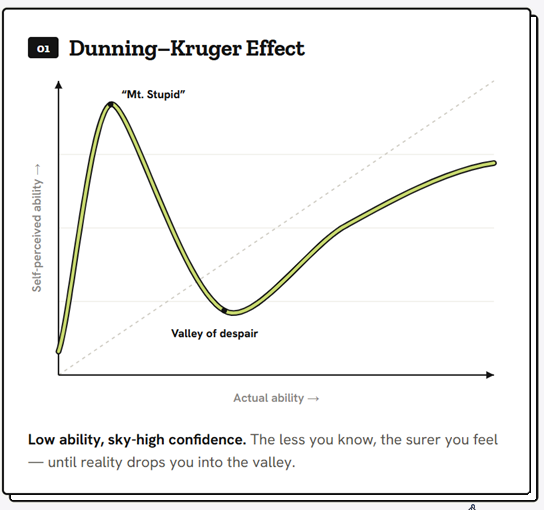
In 1999, researchers Dunning and Kruger noticed that people who lack skills or knowledge grossly overestimate how well they would perform a task. In their study they tested people on logic, grammar and humour, then asked them to rate themselves. The people who scored in the bottom quarter were the most convinced they had done well. They lacked the very skill they would have needed to notice they lacked it.
A shout out to anyone declaring how easy it is to be a TikTok influencer, make art, or the ones scolding athletes while watching from the couch.
Ever heard about the illusion of explanatory depth? It was introduced by Rozenblit and Keil in 2002. This one stings, because the illusion of knowledge comes from the basic ability to use something. How well do you think you understand how a zipper works? Research shows we can overestimate what we know simply because we have been exposed to the topic often.
And here is the good news. The fact that you are even asking whether you really understand something is proof you are not the one fooled by this. The people caught in the illusion never think to check.
The words we use create our reality
The first two are named effects and illusions. Yet in the case of impostor, we use the word syndrome. In my view, this unnecessarily pathologises what is actually a natural human experience. When Pauline Clance and Suzanne Imes first described this in 1978, they called it the impostor phenomenon: the experience of doubting your own competence and fearing you will be exposed as a fraud, even when there is clear evidence you are doing well. You assign your wins to luck or circumstance, and never quite to yourself. The word syndrome was added later, by the rest of us. So the researchers never pathologised it. The culture did.
Something shifts when we stop treating the impostor experience clinically, as something we have, a malaise of the modern age, and start looking at it instead as a completely understandable and natural effect that concerns all of us.
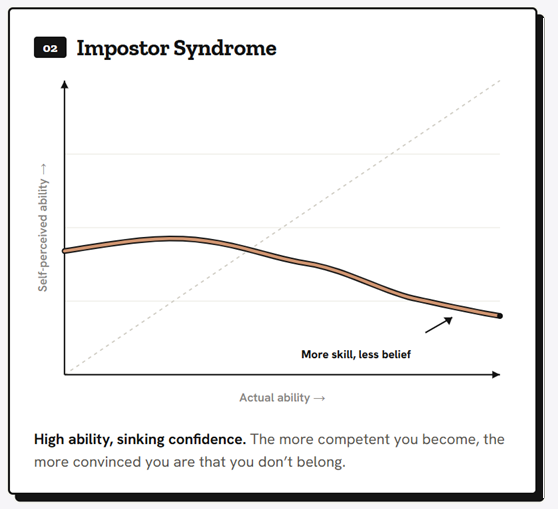
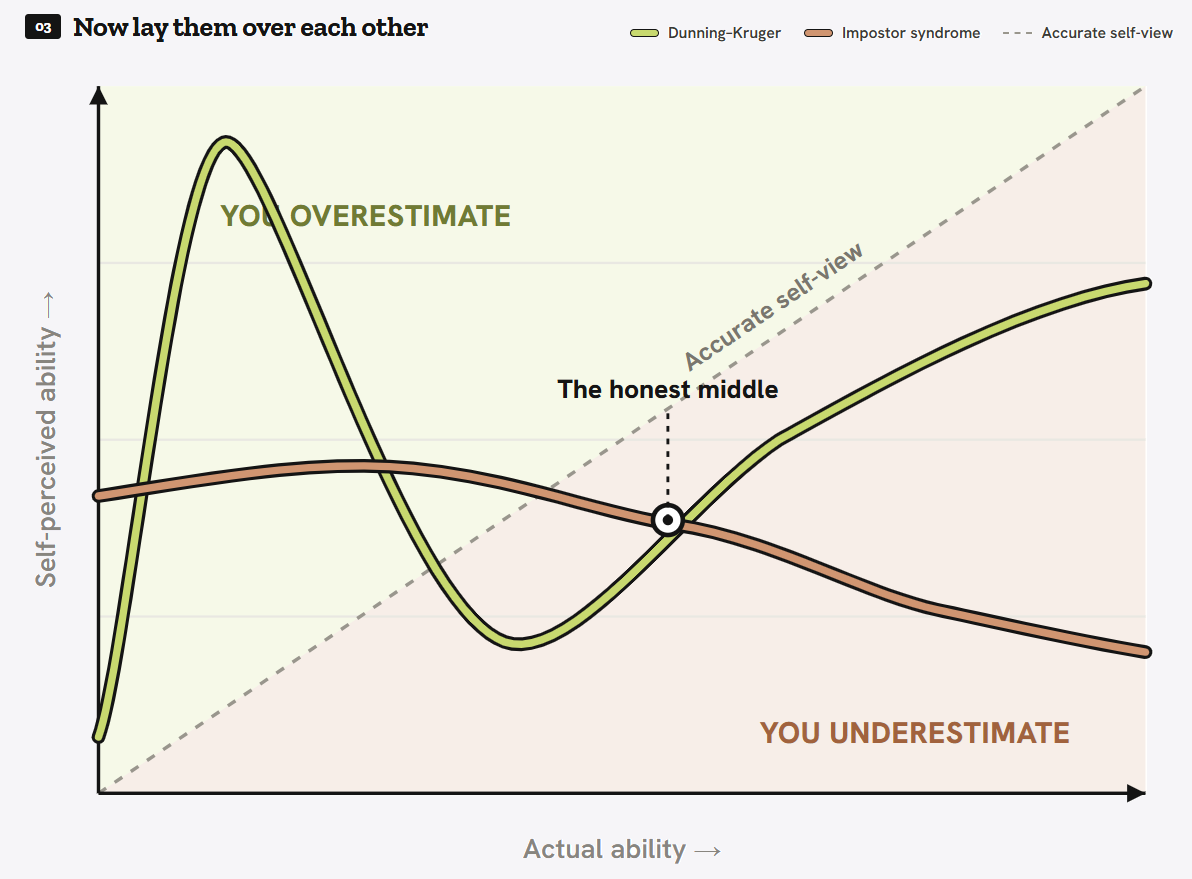
Laid over each other, these two look like opposites, and it is tempting to call them a mirror. They are not. Dunning-Kruger tracks confidence against actual skill: the less you know, the more you overrate yourself, because you lack the very knowledge you would need to notice the gap. The impostor experience is not a skill gap at all. The competence is real and the evidence keeps arriving. What breaks is the updating. Each success gets explained away, credited to luck, timing, or an easy round, so it never reaches the place where self-belief is stored. One person cannot see the evidence. The other sees it and cannot bank it. Side by side, they show the uncomfortable truth from two directions: how loosely our confidence is tied to how good we actually are.
When the doubt is not in your head
There is one more layer worth naming. There is now a body of work arguing that the impostor label can mask real systemic barriers like racism, xenophobia and classism. This is where impostor syndrome coaching does its most useful work. For an international professional building a career in German tech, the self-doubt often has a real external source. You are working in a second or third language. You are trying to read cultural cues and do your job at the same time. You are competent and experienced, and you are still spending energy on proof that your local colleagues never have to think about.
I work with my clients on both sides of this. We separate the part that is a real, structural friction worth strategising around from the part that is the old fear talking. Naming which is which is most of the work.
So what do you actually do with this?
Start by naming the specific thing that makes you feel like a fraud. Not the vague cloud of “I am not good enough,” but the actual sentence underneath it. Maybe it is “I am leading a team and I was never trained to, so I have no idea what I am doing.” Maybe it is “I am managing someone with ten more years of experience than me.”
Now test that sentence against the evidence. Is it true that you have no idea what you are doing, or is it true that you lead in a way nobody taught you and it is working? Those are very different sentences. The first is a verdict. The second is just a description of a self-taught skill, which is most skills. “I am not good at this” becomes “I have my own leadership style, and here is the evidence it works.”
This is the part the fraud feeling skips. It reaches for the worst reading and calls it a fact. Your job is to slow down and check whether the worst reading is actually the accurate one. Most of the time it is not.
And sometimes, when you check honestly, you find a real gap. That is fine too. Not every insecurity is a distortion. If managing someone more senior genuinely exposes something you have not learned yet, the answer is not to reframe it away. The answer is to close it. Read the thing, take the course, ask the person who does it well. Confidence that comes from actually building the skill is the most stable kind there is, because it is no longer a feeling you have to argue with. It is just true.
You do not have a syndrome. You are experiencing a phenomenon. And it is a signal worth reading.
Hi, I am Alicja. I am a career and confidence coach in Berlin, and I help international professionals navigate the German tech market. After fifteen years making hiring decisions on the other side of the table, I now work with people one to one on getting clear, getting seen, and getting past the fear that they have to prove themselves just a little bit more. If any of this sounded like you, let’s talk.