 Alicja
How to Be Found by AI Recruiting Tools (Tips from an AI Founder)
How to Be Found by AI Recruiting Tools (Tips from an AI Founder)
That talent hunt has changed. Faced with hundreds of mass applications per role, many generated by bots or automated application software, recruiters are going away from inbox screening and going back to active searching.
I sat down with Mina Gole, founder of the AI sourcing platform Hi Remi (hiremi.ai), to demystify how AI tools read public candidate profiles. Mina spent years as a headhunter for fast-growing startups, where every single hire could make or break the business. She built Hi Remi to eliminate the hundreds of hours recruiters waste manually scrolling through LinkedIn profiles.
“Recruiters are built to talk to people, to do stakeholder management, to do the fun part of the work… That was the main reason I built Remi. Most tools in the market were doing simple keyword research or keyword matching. What we built is a system that helps recruiters make faster decisions based on context so they can spend more time on the people’s side.” Mina Gole, Founder of Hi Remi
Why are companies rapidly adopting tools like Hi Remi? Because traditional talent sourcing comparably is inefficient. Previously, a recruiter had to do market mapping then manually review hundreds of LinkedIn profiles, cross-reference past employers, guess tech stacks, and verify context, a process that took hours just to build a small outreach list of 30 candidates. With Hi Remi, once a recruiter inputs a structured, context-rich prompt, the AI screens social media which include especially LinkedIn against those exact parameters and ranks the best matches in seconds. That massive efficiency gain is why recruiters are moving away from inbox sifting and back to active hunting.
Whether you are a job seeker trying to get found or one of the recruiters in my network looking to streamline your pipeline, understanding how Hi Remi and similar AI tools process candidate data changes the game.
Here are the key rules for getting on the radar of AI recruiting tools.
1. Optimize for Context, Not Just Keywords
Legacy LinkedIn search relied on literal keyword matching. Modern AI recruiting tools act as semantic search engines.
Recruiters don’t just type a job title into an AI tool, they feed it rich context: the hiring company’s stage, industry, business model, growth plans, target customer type, and key non-negotiables. The tool then ranks candidate profiles based on how closely their background maps to that full picture.
- Ditch “clever” titles: AI tools look for standard industry language. Using non-standard titles like “Product Ninja” or “Growth Wizard” makes you harder to index. Use the plain, standard title a recruiter would actually search for.
- Think SEO: Treat your LinkedIn profile like a landing page. If you want a specific customer ,in this case, a specific type of recruiter to get to your profile, use the exact terminology, frameworks, and tools common to that target role.
2. Match the “Two Signals”: Role vs. Environment
When AI tools evaluate a profile, screening rests heavily on two indicators: Role Track Record and Environmental Track Record.
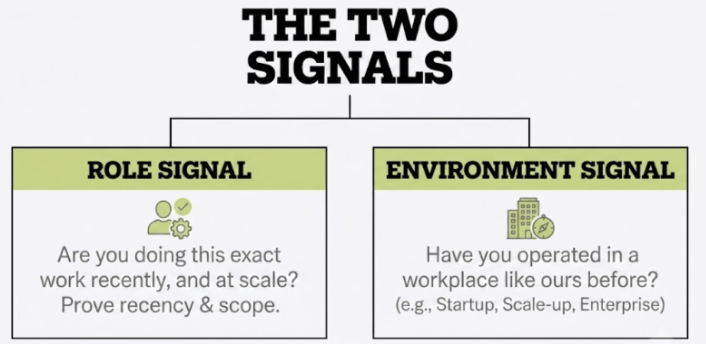
Signal 1: The Role Track Record
This answers a simple question: Have you done this job recently, in a relevant setting, and with a similar level of responsibility? It covers the functional shape of your career, your day-to-day output, responsibilities, and core competencies.
Signal 2: The Environmental Track Record
This is the part many people leave invisible. Companies rarely hire purely for functional skill without organizational context. A regulated bank looks for candidates who have survived strict regulatory oversight. A fast-growing startup looks for people who have navigated shifting priorities and resource constraints.
- Actionable Tip: If you are transitioning between environment types (e.g., startup to enterprise), actively reframe your experience. Highlight the mechanisms valued by your target environment, such as enterprise software stacks, cross-functional stakeholder management, process creation, and governance rather than just fast-paced execution.
3. Bring Evidence, Not Buzzwords
Adjectives like motivated, creative, strategic thinker, or entrepreneurial mindset add little value to your profile (or CV!). AI algorithms ignore them, and recruiters pass right over them. You cannot prove a self-proclaimed personality trait in a profile text, focus on showing the work you have done.
- Replace claims with facts: State the customer segments you worked with, your industry focus, team sizes led, tools managed, and concrete outcomes delivered.
- Show project parameters: Include metrics like budget size, system architecture scale, or feature shipping velocity. Let the machine and the human draw conclusions from facts, not self-praise.
4. Anchor Skills Inside Recent Roles (With Exact Versions)
A block of 50 standalone skills tagged at the bottom of a LinkedIn profile may seem like a good idea, and sure the keyword will point to you, but the ranking is made by looking at a combination of other things.
- Context matters: Place tools, frameworks, and languages directly inside the specific job entry where you used them. AI tools rank candidate skill matches higher when those skills are tied to active, recent employment history.
- Recency is key: A skill used in the last 2–3 years carries vastly more weight than one touched five years ago.
- Be precise: Don’t just list C++ or React. Specify C++17 or React 18. Specificity demonstrates currency and helps algorithms match you to exact tech stack requirements.
- Avoid negative keywords: Phrases like “I write Java, not JavaScript, please stop asking” backfire. Keyword engines will still pick up JavaScript on your page, forcing the tool to process and then disqualify you. Keep your text purely affirmative and literal.
5. Leverage Your Employers’ Context Data
Advanced AI tools evaluate the entities on your profile. They pull data from your past employers to understand your experience context automatically, even if you didn’t explicitly spell it out in your description.
- Tag official company pages: Always link your employment entries to the official, verified LinkedIn company page. This lets the AI pull metadata like business model (e.g., B2B SaaS), funding stage, headcount, and domain automatically.
- Add a one-line company summary: If you worked for a company that isn’t widely known in your target job market, add a single explanatory line right under the job title:
Example: “Acme Corp - B2B Fintech startup providing real-time payments API (Series B, 80 employees).“
6. The Reality Check: AI Inherits Human Limitations (and Biases)
It is easy to imagine AI as an all-seeing, perfectly objective super-intelligence. The reality today is far more human: an AI recruiting tool is only as impartial as the person setting its instructions.
If a recruiter trains a tool to prioritize candidates from “Big 4” consulting firms or specific elite universities, the AI will execute that bias at scale. The machine doesn’t make the rule, it simply accelerates the human habit behind it.
Understanding this limitation is crucial, especially when dealing with common anxieties like career gaps, layoffs, or non-linear paths.
7. How AI Handles Gaps and Layoffs
The biggest fear candidates bring to coaching sessions is that an AI will quietly rule them out for a career break or a recent layoff.
Here is what actually happens: the tool does not automatically punish gaps unless the recruiter specifically asks it to. In fact, many modern recruiters deliberately instruct tools to find “hidden gem” candidates who have taken breaks or faced layoffs, knowing they often bring deep commitment, resilience, and fresh perspective.
To ensure an AI (and the recruiter behind it) views your gap as a mark of intentionality rather than a red flag:
- Name the Gap: An unexplained gap forces both the algorithm and the reader to make assumptions. Use LinkedIn’s built-in “Career Break” feature or create a structured entry. State the facts neutrally in 1–2 sentences: “Career Break — Strategic job search and professional upskilling following company-wide restructuring.”
- Bridge the Gap with Evidence: AI tools scan for continuity of skills, not just employment status. Use your gap period to highlight ongoing growth. List freelance projects or detail specific certifications/tools learned during the break.
- Focus on Relevance Over Perfection: A recruiter using AI is searching for matching signals, not a flawless timeline. If you provide enough strong evidence: the right environments, exact tool versions, and clear project outcomes a well-configured tool will surface you anyway.
8. Treat LinkedIn as an Inbound Landing Page
Unlike a CV, which you can rewrite for every single application, your LinkedIn profile is a single public document. As Mina emphasized, your public profile is increasingly becoming more important than the CV itself.
Mina’s final piece of advice summarizes the ultimate strategy:
“See it like marketing. Think: ‘What is the kind of company I want to be part of? What is the role I want to attract?’ And then optimize for that. Don’t optimize for one job ad or another… Show what you have actually done: the team sizes led, the tools used, the features shipped, and the impact you had.”
Optimizing your profile for AI sourcing tools isn’t about gaming an algorithm or tricking software. It is about presenting clear, structured facts so that tools like Hi Remi can connect you with recruiters who are actively looking for exactly what you bring to the table.

Tired of sifting through hundreds of bot applications? If your recruiting team is spending hours manually building talent pipelines on LinkedIn, Hi Remi gives you that time back. Reduce repetitive research from hours to seconds and focus your energy on high-quality conversations with top-tier candidates.
👉 Explore Hi Remi (hiremi.ai) to see how AI context sourcing can transform your hiring efficiency.